Getting into Weill Cornell Medicine
Weill Cornell Medicine, on Manhattan's Upper East Side, is one of the country's leading academic medical programs — and it reports median GPA and MCAT for its entering class while stating plainly that there are no MCAT cutoffs. That honesty is worth taking at face value. No admission odds here, just verified facts and how to read them.

Updated September 2026 · 2026–2027 cycle · figures cited to Weill Cornell's official admissions pages
What is Weill Cornell's mission — and what does it signal?
Care. Discover. Teach. — committed to exemplary and individualized clinical care, groundbreaking biomedical discovery, and educating the next generation of exceptional doctors and scientists.Weill Cornell Medicine, on its mission3
That three-word mission is a real signal: care, discovery, and teaching sit together. Weill Cornell is an academic medical center in the middle of New York's research world, so applicants who can point to genuine inquiry alongside patient care fit the story it tells about itself.
What GPA and MCAT does Weill Cornell require?
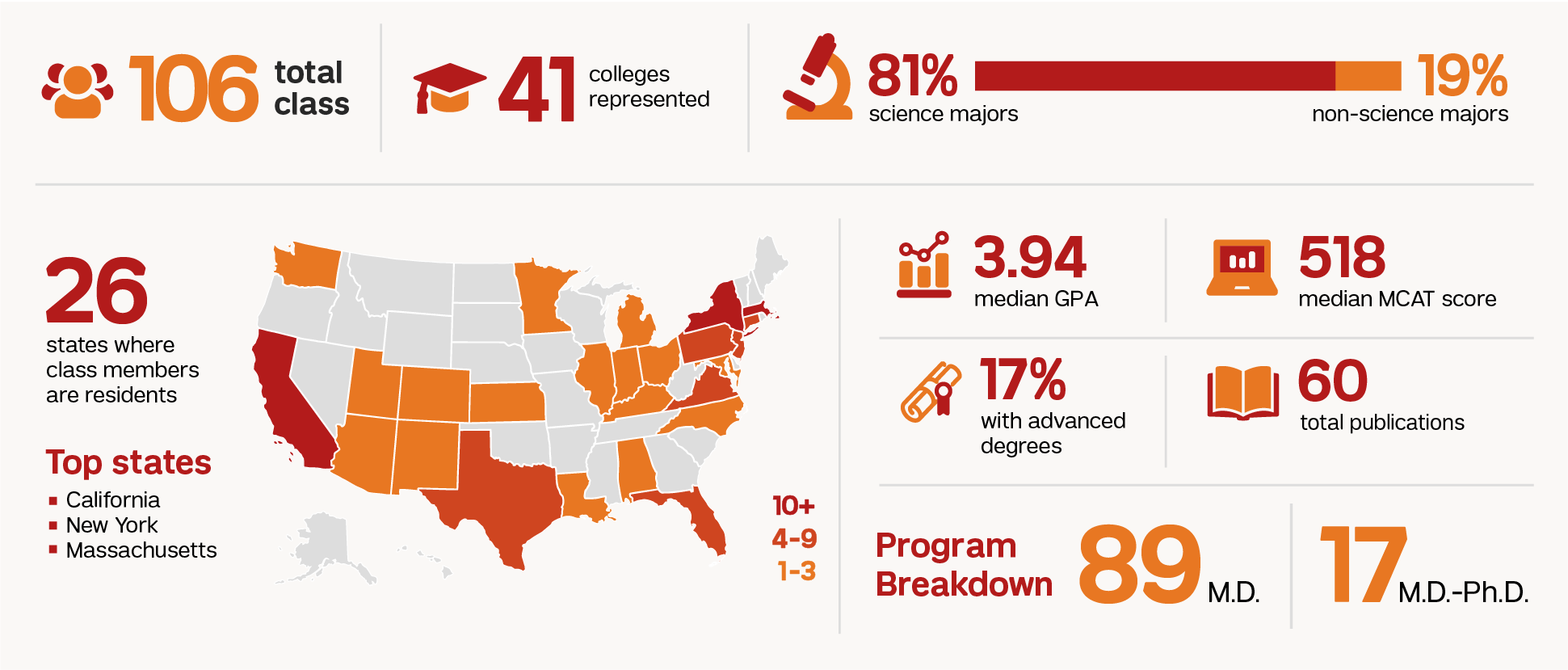
Weill Cornell reports median figures for the class that entered in 2026: a GPA of 3.94 and an MCAT of 518. Those medians include 17 MD-PhD students.1 It also states there are no MCAT cutoffs.2 The takeaway isn't that scores don't matter — it's that Weill Cornell reads the whole application and won't screen you out on a single number. Build the strongest, most coherent application you can rather than chasing one figure.
What does Weill Cornell require to apply?
Weill Cornell lists clear course expectations: two semesters each of biology, general chemistry, physics, and organic chemistry (with lab), plus two semesters of writing-intensive coursework in the humanities or social sciences.2 Letters of evaluation are required and, in the committee's words, "play an important role." An MCAT no older than three years is required. Confirm the current cycle's CASPer or PREview expectations on the Weill Cornell page.
Does Weill Cornell use the MMI — and what is the interview like?
Weill Cornell uses a traditional interview, not an MMI — typically two 30-minute virtual interviews with committee members for the 2026–27 season, plus an informational session and a student Q&A.2 That format rewards depth: being able to talk through your experiences and reasoning in a real conversation.
How much does Weill Cornell cost?
Weill Cornell publishes its MD tuition and cost of attendance on its official financial aid pages — confirm the current figure there.4 Weill Cornell is well known for substantial need-based financial aid, so the price many students actually pay differs from the sticker; study its aid pages closely rather than assuming the published tuition is your number.
A school that won't screen you on a number — so don't screen yourself.
Weill Cornell's refusal to publish cutoffs is a gift to honest applicants: it's telling you the whole application matters. That's exactly how we think — no odds, no fake bar. Show real inquiry and real care, put together a coherent story, and let a school that reads holistically read it. A judgment about fit, not a prediction of admission.
See exactly where you stand — at Weill Cornell and every school on your list
Preceptorly is admissions software built by a practicing physician. It matches your real numbers to each school's published averages — never fake odds — and coaches the parts that actually decide your cycle:
Keep going
Frequently asked
What GPA and MCAT do you need for Weill Cornell Medicine?
For the class that entered in 2026, Weill Cornell reports a median GPA of 3.94 and a median MCAT of 518, including 17 MD-PhD students, and it states there are no MCAT cutoffs. Rather than chase a number, build the strongest, most coherent whole application you can.
Does Weill Cornell really have no MCAT cutoff?
Yes — its official admissions page states “There are no cutoffs for MCAT scores.” An MCAT no older than three years is required, but there's no published minimum.
Does Weill Cornell use an MMI?
No. Weill Cornell uses a traditional interview — typically two 30-minute virtual interviews with committee members — rather than a multiple-mini-interview.
What are Weill Cornell's prerequisites?
Two semesters each of biology, general chemistry, physics, and organic chemistry (with lab), plus two semesters of writing-intensive coursework in the humanities or social sciences. Confirm current requirements on the Weill Cornell site.
How much is tuition at Weill Cornell Medicine?
Weill Cornell publishes MD tuition and cost of attendance on its official financial aid pages — confirm the current figure there. It offers substantial need-based aid, so many students pay less than the sticker.
How big is the Weill Cornell class?
Weill Cornell selects 106 students from over 9,000 applicants; that total includes 17 MD-PhD students (class size 89, entered 2026).
Sources — Weill Cornell official pages
- Class size (106 selected from over 9,000 applicants), "no MCAT cutoffs," prerequisites, letters & interview format ("Selection Criteria & Requirements"): weill.cornell.edu — selection criteria & requirements; median GPA, median MCAT and class size, entered 2026: Class of 2030 profile
- How to apply & application requirements: weill.cornell.edu — how to apply
- Mission ("Care. Discover. Teach.") & program identity: weill.cornell.edu — medical education
- Tuition, cost of attendance & financial aid (confirm current figure): weill.cornell.edu — cost & financial aid
Preceptorly is not affiliated with this school and does not represent it. Figures are the school's own most recently published class data and are averages, medians, or ranges as labeled — not cutoffs. No acceptance rate or admission odds are shown or implied; this page does not predict admission. Tuition is the published tuition line only, before fees, insurance, and living costs. Always confirm current requirements and figures on the school's official pages.